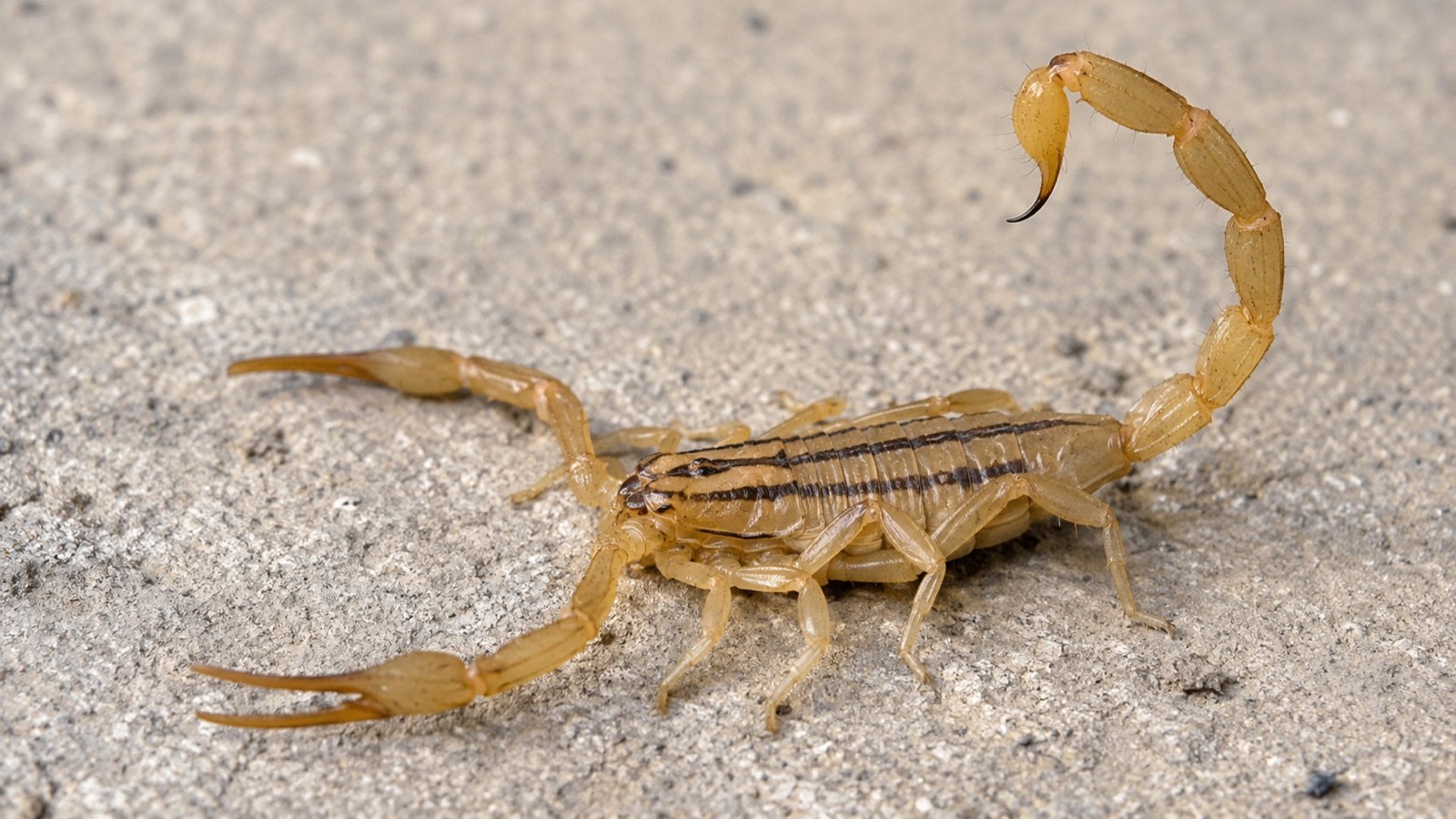
If you found a scorpion in Texas or a neighboring state, this is almost certainly the one. Its sting is painful, like a bad wasp sting, but the venom is a mild neurotoxin that is almost never dangerous to a healthy adult.1 The scorpion that is genuinely dangerous is a different animal, the Arizona bark scorpion, and the two bold stripes down this one’s back are the quickest way to tell them apart.
The striped bark scorpion (Centruroides vittatus) is the most common and most widely distributed scorpion in the United States.1 It turns up on walls, in garages and attics, and under woodpiles, boards, and loose bark.2 This page covers how to be sure that is what you have, how worried to actually be, and how it fits into the rest of this guide.
How to identify it
Four features together make a confident identification. Any one alone is not enough, but the combination is distinctive.
| Size | Small. Commonly around 2 to 2.5 inches long counting the tail;2 the Missouri Department of Conservation lists an average body length of 1 to 1.5 inches.1 |
|---|---|
| Color | Pale yellowish tan to yellowish brown.12 |
| The two stripes | Two broad, dark lengthwise stripes down the back. The signature mark and the fastest way to separate it from the dangerous look-alike.2 |
| Head marking | A dark triangle on top of the head, above the eyes.12 |
| Pincers and tail | Slender pincers (pedipalps) and a long, slender tail, rather than thick, crab-like claws.2 |
Why some do not look striped
The pattern varies. Young scorpions show the stripes clearly, while older ones can be a more uniform dark brown with the stripes faint or missing.1 In far West Texas, around the Big Bend, some populations are only faintly marked or nearly pale.2 If the stripes are unclear, fall back on the slender pincers, the slim tail, and the dark head triangle.
Is it dangerous?
For most people, no. A sting hurts, but the venom of this species is a comparatively mild neurotoxin and is almost never life-threatening.1 Only one scorpion in the United States is considered medically significant, the Arizona bark scorpion (Centruroides sculpturatus, also written C. exilicauda), and there have been no reported scorpion deaths in Arizona since 1968.3 The striped bark scorpion is not that animal.
A typical sting brings local pain and a pins-and-needles or numb feeling at the site, much like a bee or wasp sting, and usually settles on its own.3
Serious, whole-body reactions are uncommon with this species but not impossible, and small children are more likely to react severely.3 Seek medical care right away for any of these:
- Trouble breathing or swallowing
- Roving or jerking eye movements, muscle twitching or jerking3
- Drooling, restlessness, or agitation out of proportion to the pain3
- Signs of an allergic reaction: swelling spreading beyond the sting, hives, dizziness1
- The person stung is a young child, or has a known sting allergy
Full guidance is on the first-aid page and the is-it-dangerous page.
The one it gets confused with
The Arizona bark scorpion looks broadly similar in shape and size but lacks the two bold dark stripes, and its venom is genuinely medically significant.3 Its range centers on the desert Southwest, whereas the striped bark scorpion dominates Texas and the south-central states, so in most of that homeowner belt the dangerous species is simply not present. When a scorpion is hard to identify, treat it with caution and use the comparison page.
Where it lives and how it behaves
Striped bark scorpions favor dry, warm places and shelter under rocks, logs, loose bark, woodpiles, brush, and debris. They also turn up in and around buildings, and they climb, which is why they are often found in attics.2 In Texas the species occurs throughout the entire state, and it is the only scorpion found across all of Texas.2
They are nocturnal hunters. At night they come out to hunt soft-bodied prey such as spiders, cockroaches, ants, crickets, and beetles, grabbing prey with the pincers and using the stinger to subdue it.1 During the day they hide in cool, tight spaces, which is why an encounter often happens when someone moves firewood or reaches into a dark corner. How they get indoors and how to keep them out are covered on the habitat and control pages.
Life cycle and lifespan
Unlike most insects, scorpions do not lay eggs. The female gives birth to live young.1 Scorpions are long-lived for their size: they generally live three to seven years, and some individuals survive far longer.1 Full detail on birth, the young riding on the mother’s back, and molting is on the life-cycle page.
Why it glows under a blacklight
Like all scorpions, the striped bark scorpion fluoresces a bright blue-green under ultraviolet light. Compounds in the outer layer of its shell absorb UV and re-emit it as visible light.4 That is not just trivia: a cheap UV flashlight is the single most effective way to find these scorpions at night, which is why it has its own page under control and detection.
Sources
- Missouri Department of Conservation. “Striped Bark Scorpion,” MDC Field Guide. mdc.mo.gov. Accessed 2026-07-20.Backs: most widely distributed US scorpion, average body length, color and stripes, live birth, three to seven year lifespan, mild neurotoxin that is almost never life-threatening, nocturnal prey.
- Texas A&M AgriLife, Field Guide to Common Texas Insects. “Striped Bark Scorpion (Centruroides vittatus).” texasinsects.tamu.edu. Accessed 2026-07-20.Backs: size counting the tail, slender pincers and tail, the two stripes and head triangle, pale Big Bend forms, statewide Texas distribution, climbing and attic habit.
- Shamoon Z, Rerolle S, Nelson JA, et al. “Scorpion Toxicity.” StatPearls, NIH/NCBI Bookshelf. ncbi.nlm.nih.gov. Accessed 2026-07-20.Backs: the Arizona bark scorpion is the only medically significant US species, no Arizona deaths since 1968, mild-sting symptoms, severe-reaction warning signs, children at higher risk.
- Rubin M, Lamsdell JC, Prendini L, Hopkins MJ. “Cuticular fluorescence is plesiomorphic in chelicerates.” Journal of Zoology, 2017. research.amnh.org. Accessed 2026-07-20.Backs: the scorpion cuticle fluoresces under ultraviolet light, absorbing UV and re-emitting it as visible blue-green light.