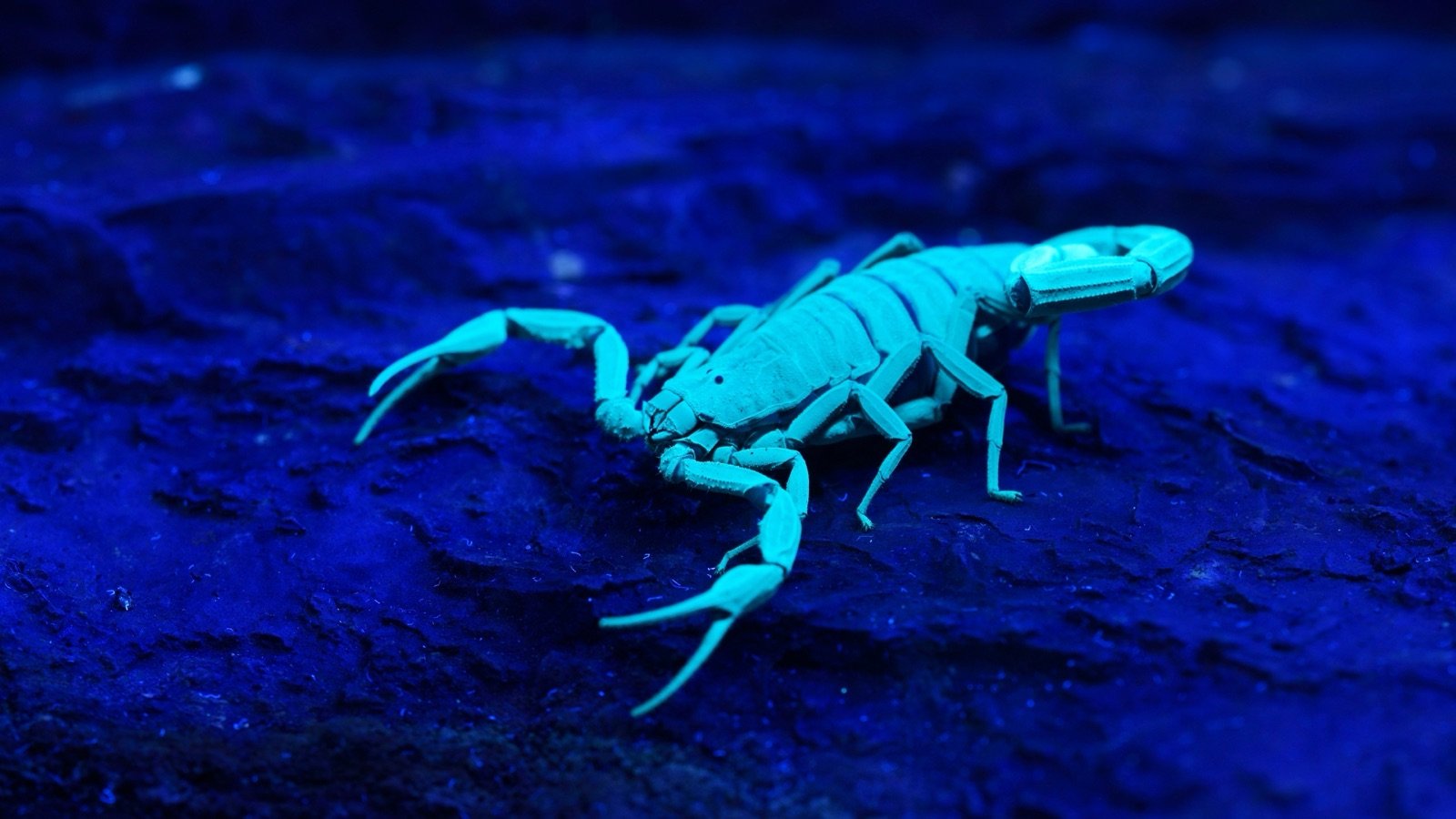
The chemistry behind the glow
The glow comes from the cuticle, specifically a thin transparent zone called the hyaline layer of the exocuticle. Two compounds there are responsible: a beta-carboline and 4-methyl-7-hydroxycoumarin.1 The beta-carboline was identified in 1999 (in work that noted a chemical echo between scorpion cuticle and human cataracts), and the second compound was pinned down in 2001.31
It is worth being precise about what “glow” means here. This is fluorescence: the shell absorbs long-wave UV and instantly re-emits it as visible light. The scorpion is not producing light chemically the way a firefly does.1 The effect appears only as the cuticle hardens, so a freshly molted scorpion does not fluoresce, and the glow strengthens with each successive molt.1
Why they glow: still an open question
Here is where an honest reference has to resist a tidy answer. The adaptive purpose of scorpion fluorescence is debated, and for a long time no function had been demonstrated at all.12 Researchers have proposed several ideas over the years, including that the glow helps the scorpion detect UV and gauge light levels, that it helps scorpions recognize each other, that it lures prey, that it protects against the sun, or that it has no purpose and is simply a byproduct of the cuticle hardening.2
The strongest experimental evidence so far comes from a 2010 study that reduced scorpions’ fluorescence and found their behavior under UV light changed, which the authors read as the first experimental support for the light-detection idea; earlier tests of the prey-luring and mate-recognition ideas had not found support.2 More recently, finding the same fluorescent hyaline layer in horseshoe crabs and extinct sea scorpions has suggested the trait may be an ancient, inherited feature of this whole animal group rather than a purpose-built adaptation, which would argue against several of the proposed functions.1
Whatever its purpose, the glow has one very practical use for people: it makes scorpions easy to find at night with a cheap UV flashlight. See finding scorpions with a blacklight.
Sources
- Rubin M, Lamsdell JC, Prendini L, Hopkins MJ. “Cuticular fluorescence is plesiomorphic in chelicerates.” Journal of Zoology, 2017. research.amnh.org. Accessed 2026-07-20.Backs: fluorescence from beta-carboline and 4-methyl-7-hydroxycoumarin in the hyaline layer of the exocuticle; it is fluorescence tied to cuticle hardening (freshly molted scorpions do not fluoresce); all scorpions fluoresce; the same hyaline layer in horseshoe crabs suggests an ancient inherited trait; adaptive significance debated.
- Kloock CT, Kubli A, Reynolds R. “Ultraviolet light detection: a function of scorpion fluorescence.” Journal of Arachnology, 2010. americanarachnology.org. Accessed 2026-07-20.Backs: no function had previously been demonstrated; the list of proposed functions; first experimental support for the UV light-detection function; prey-luring and mate-recognition ideas unsupported; fluorescence can be reduced experimentally.
- Stachel SJ, Stockwell SA, Van Vranken DL. “The fluorescence of scorpions and cataractogenesis.” Chemistry & Biology, 1999. pubmed.ncbi.nlm.nih.gov. Accessed 2026-07-20.Backs: identification of the beta-carboline fluorescent compound and the chemical link between scorpion cuticle and human cataracts.