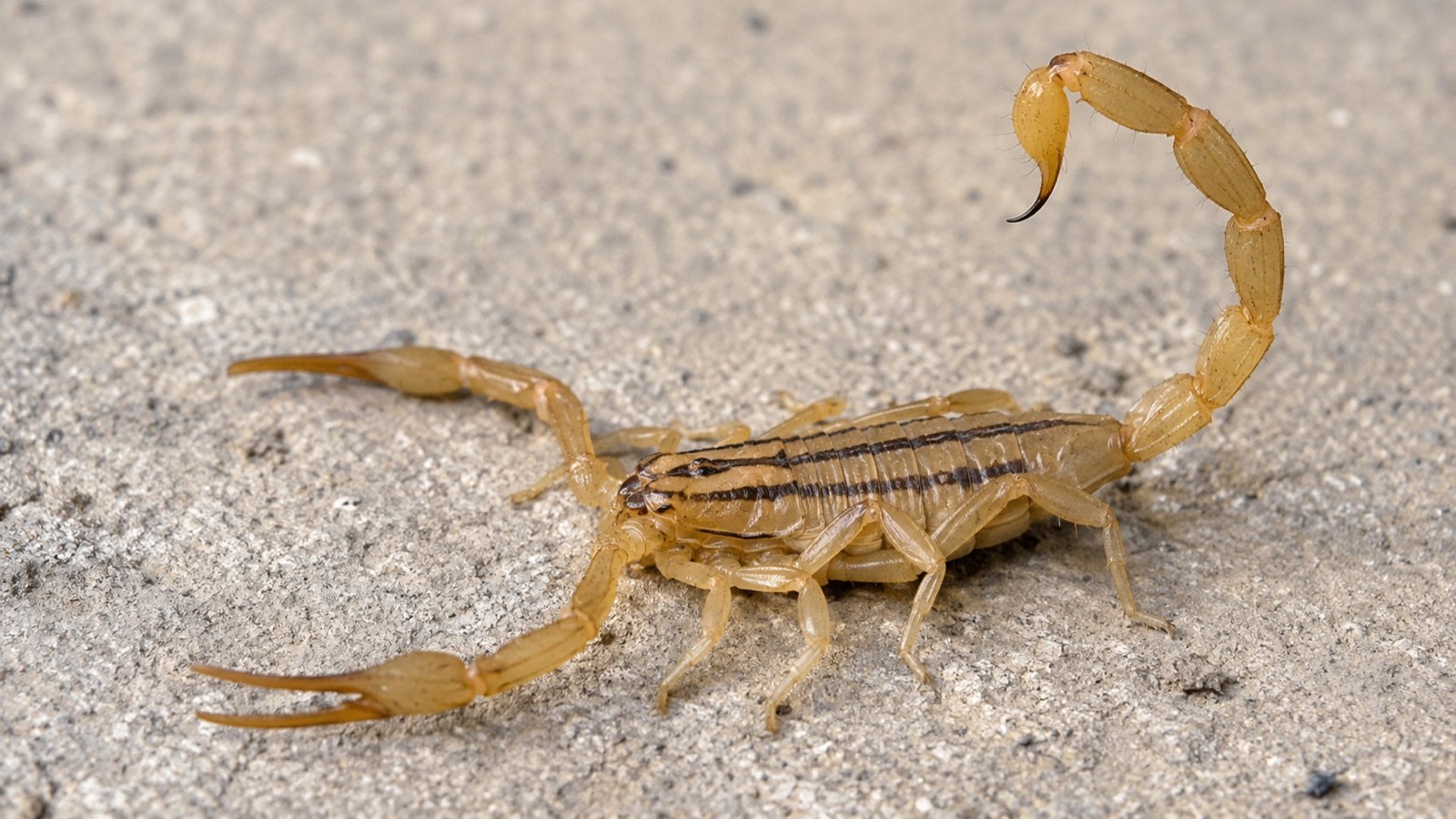
The striped bark scorpion has two bold dark stripes down its back and lives across the south-central states. The Arizona bark scorpion lacks those stripes, lives in the desert Southwest, and is the one scorpion in the country whose sting is a real medical concern.25 In most of Texas, Oklahoma, Arkansas, and Missouri, the dangerous species is simply not present.
How they look different
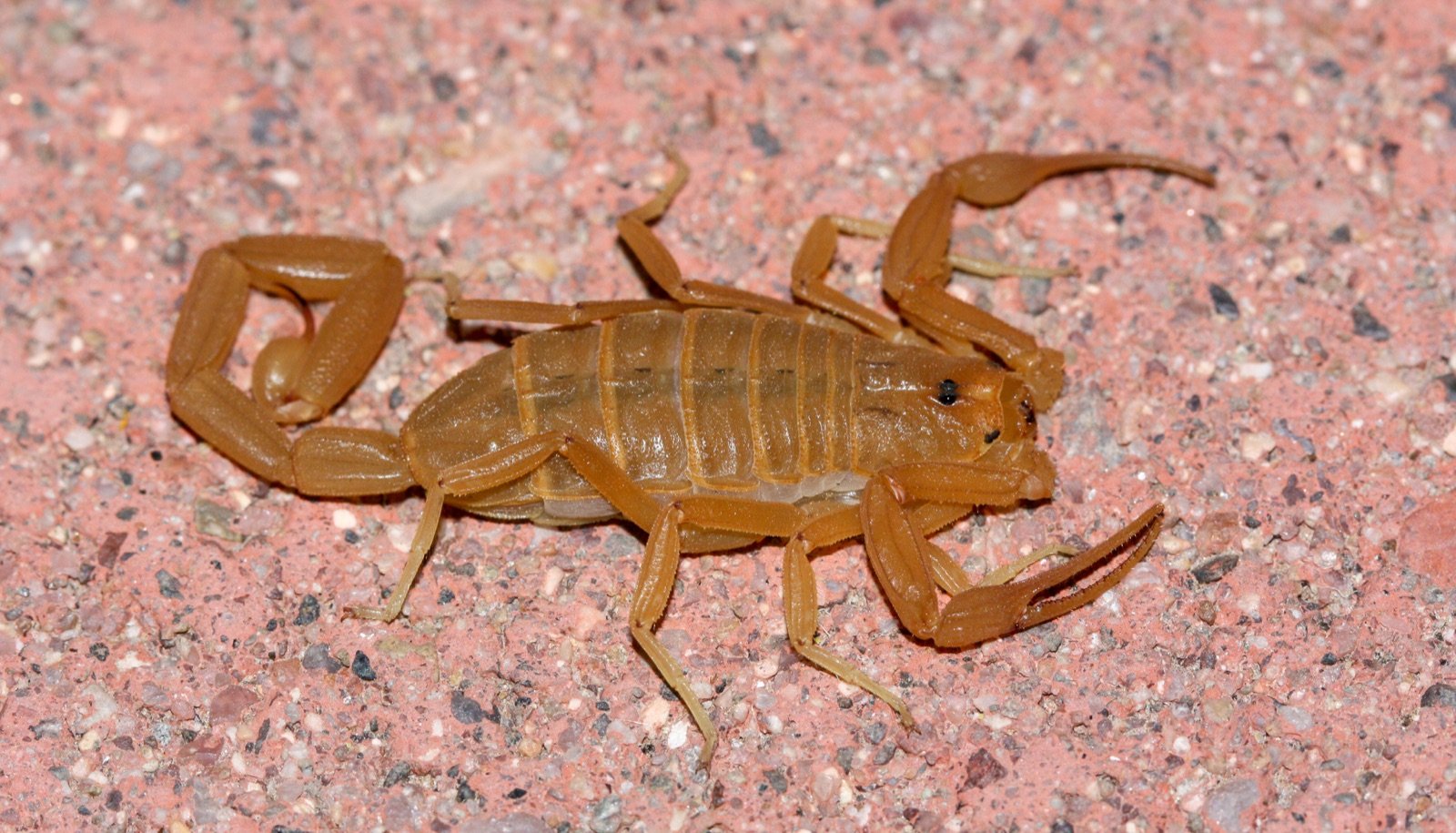
Both are in the genus Centruroides, so both have slender pincers and a long, slim tail. That shared build means tail and pincer shape alone will not separate them.15
How their ranges differ
The striped bark scorpion is the most widespread scorpion in the country, ranging across the south-central and southwestern US and into northern Mexico.3 The Arizona bark scorpion is a desert Southwest species, centered on Arizona, with smaller populations in parts of California, Nevada, New Mexico, Utah, Colorado, and Texas.5 It favors riparian, streamside desert habitat.4
The two range descriptions overlap mainly in western Texas and New Mexico. Across most of the south-central homeowner belt, central and eastern Texas, Oklahoma, Arkansas, and Missouri, the Arizona bark scorpion is not present, so a striped scorpion found there is the striped bark scorpion.35 (The exact overlap boundary is inferred from two agency range statements, not a single mapped source.)
The difference that matters
The Arizona bark scorpion is described by extension entomologists as the only scorpion of medical concern in the United States and the most venomous scorpion in North America.45 Its stings can cause the severe, whole-body symptoms that require antivenom in some cases.6 The striped bark scorpion’s venom, by contrast, is a comparatively mild neurotoxin, and no Texas scorpion is considered lethal.12
Homeowner takeaway: geography plus the two stripes and the head triangle is the most reliable separator. When you cannot be sure, treat the scorpion as if it could sting and read the first-aid page.
Naming note: medical sources often call the Arizona bark scorpion Centruroides exilicauda, while field guides use Centruroides sculpturatus. Both names have been applied to this animal.
Sources
- Texas A&M AgriLife, Field Guide to Common Texas Insects. “Striped Bark Scorpion (Centruroides vittatus).” texasinsects.tamu.edu. Accessed 2026-07-20.Backs: both species share slender pincers and a long tail; the striped bark scorpion has two stripes and a head triangle; no Texas scorpion is lethal.
- Missouri Department of Conservation. “Striped Bark Scorpion,” MDC Field Guide. mdc.mo.gov. Accessed 2026-07-20.Backs: the striped bark scorpion has two dark stripes and a mild neurotoxin venom.
- Missouri Department of Conservation. “Striped Bark Scorpion,” MDC Field Guide. mdc.mo.gov. Accessed 2026-07-20.Backs: the striped bark scorpion is the most widely distributed US scorpion, ranging across the south-central US and northern Mexico.
- U.S. National Park Service. “Arizona Bark Scorpion.” nps.gov. Accessed 2026-07-20.Backs: the Arizona bark scorpion is tan with a darker back, lives in Sonoran Desert riparian habitat, and is the most venomous scorpion in North America.
- University of Arizona Cooperative Extension (Community IPM). “Scorpions” (Public Health IPM). acis.cals.arizona.edu. Accessed 2026-07-20.Backs: the Arizona bark scorpion is the only scorpion of medical concern in the US; its range covers Arizona and small parts of neighboring states; color varies.
- Shamoon Z, Rerolle S, Nelson JA, et al. “Scorpion Toxicity.” StatPearls, NIH/NCBI Bookshelf. ncbi.nlm.nih.gov. Accessed 2026-07-20.Backs: severe envenomation can require antivenom and is associated with the dangerous species.