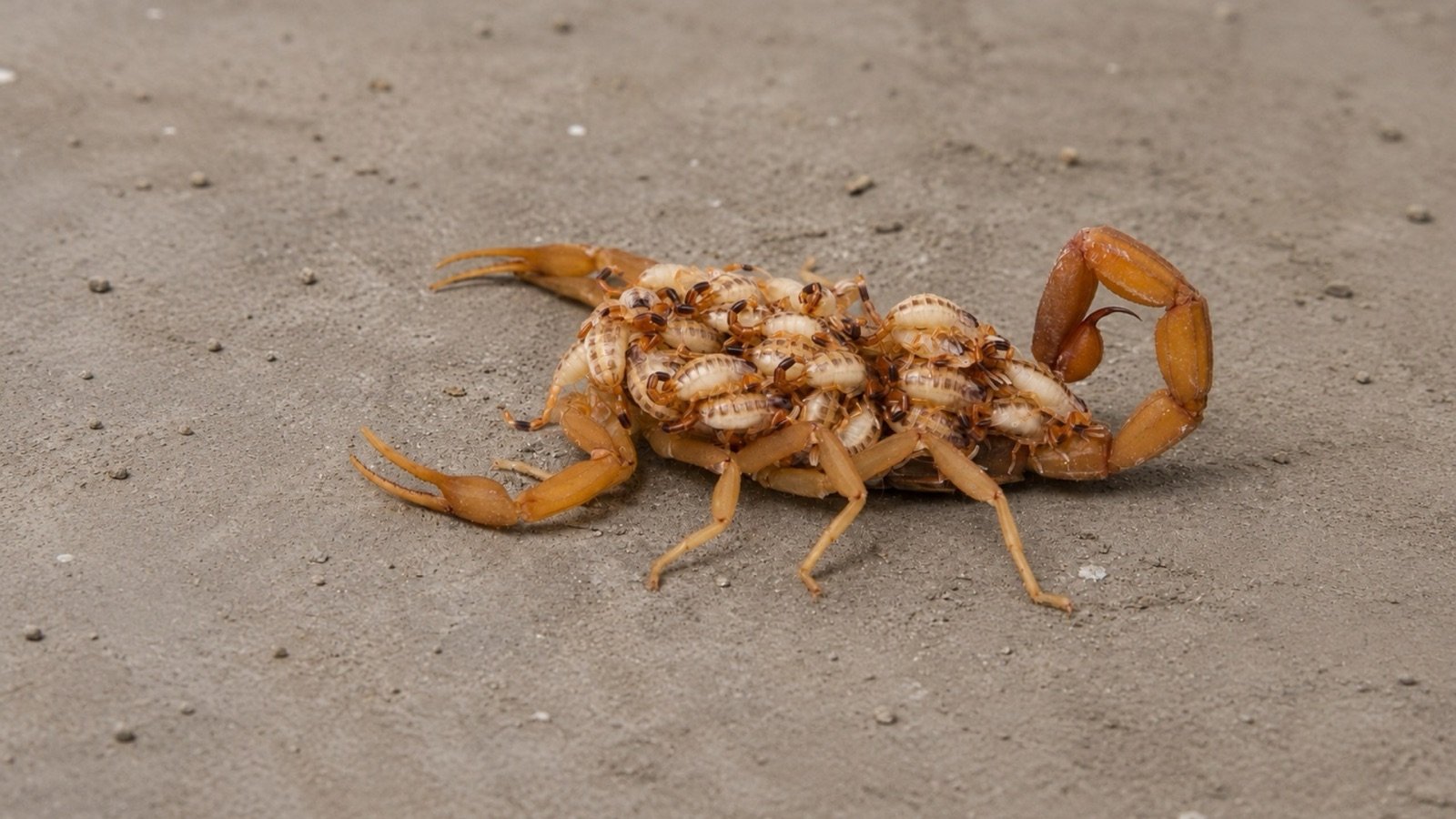
The popular claim that baby scorpions are more venomous, or cannot control their venom, is false for the striped bark scorpion. A peer-reviewed study found adult venom is about 2.7 times more potent than juvenile venom.3
What young ones look like
Young striped bark scorpions are pale yellowish brown, and the two dark stripes actually stand out more clearly against the lighter body; individuals darken as they age.12 Scorpions grow by molting rather than metamorphosis, so a juvenile looks like a miniature adult, just paler and smaller.1 Females bear live young, and Texas A&M reports litters of 13 to 47, averaging about 31.2
The “babies are more venomous” myth
You will hear that baby scorpions are deadlier than adults because they cannot control how much venom they inject. For the striped bark scorpion, the science says the opposite. In a controlled study, adult venom was about 2.7 times more potent than juvenile venom: it took much less adult venom to reach the same effect, and adult venom incapacitated prey faster.3 The researchers even found that adults and juveniles express different toxin genes, matching the higher adult potency.3
On the “cannot control their venom” idea: scorpions can actually meter their venom and even deliver venom-free “dry” stings. In one study of bark scorpions, nearly 12 percent of defensive stings delivered no venom at all, interpreted as the animal conserving a costly resource.4 There is no approved-source evidence that a juvenile striped bark scorpion sting is more dangerous than an adult’s.3
Bottom line: a sting from a young striped bark scorpion should be treated the same as any sting from this species, painful and local, and the first-aid steps are identical.
Sources
- Missouri Department of Conservation. “Striped Bark Scorpion,” MDC Field Guide. mdc.mo.gov. Accessed 2026-07-20.Backs: young are pale with clear stripes and darken with age; scorpions grow by molting; live birth.
- Texas A&M AgriLife, Field Guide to Common Texas Insects. “Striped Bark Scorpion (Centruroides vittatus).” texasinsects.tamu.edu. Accessed 2026-07-20.Backs: litters of 13 to 47 young, averaging about 31.
- Ward MJ, Ellsworth SA, Rokyta DR, et al. “Differential toxicity and venom gland gene expression in Centruroides vittatus.” NIH/PMC (PMC5627916). pmc.ncbi.nlm.nih.gov. Accessed 2026-07-20.Backs: adult venom is about 2.7 times more potent than juvenile venom, incapacitates prey faster, and adults and juveniles express different toxin genes.
- “Risk Assessment and Venom Expenditure by Arizona Bark Scorpions in a Defensive Context.” NIH/PMC (PMC12030811). pmc.ncbi.nlm.nih.gov. Accessed 2026-07-20.Backs: scorpions can meter venom and deliver venom-free dry stings; nearly 12 percent of defensive stings delivered no venom.